
Climate Futures APAC Summit 2026 Lands in Bangkok as Singapore Treasure Carbon Joins Regional Climate Dialogue
06-19
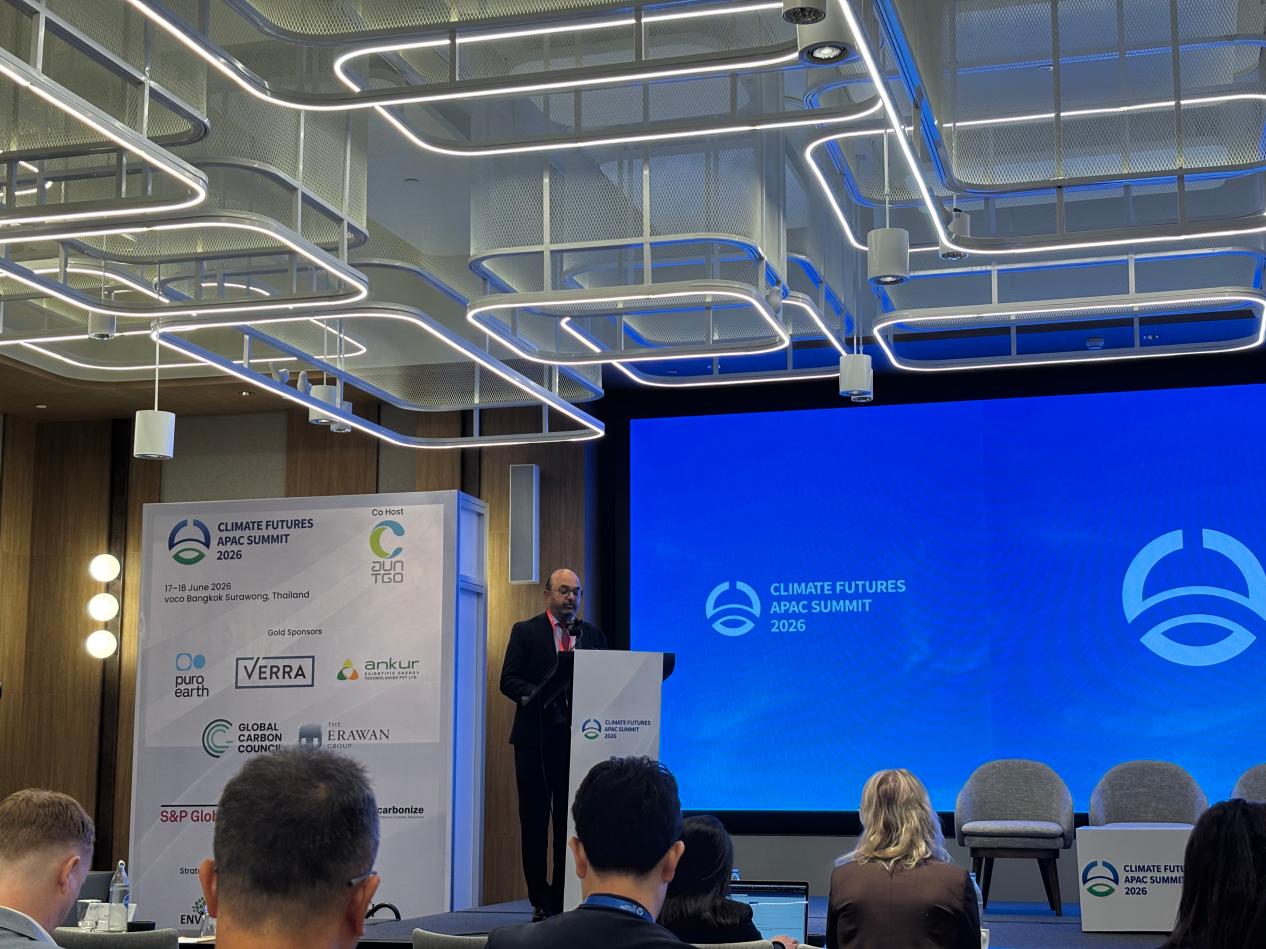
Climate Futures APAC Summit 2026 (CFAS) was held in Bangkok, Thailand, on 17–18 June. Described by organizers as Asia-Pacific’s most comprehensive carbon and climate summit, the event took place amid accelerating climate policy implementation and carbon market development across the region.
Over the past two years, economies across Asia-Pacific have continued to strengthen climate policies and carbon market frameworks. Thailand has advanced its net-zero target from 2065 to 2050. Its Draft Climate Change Act, currently under parliamentary review, is expected to support an integrated carbon pricing framework integrating emissions trading, carbon taxation and carbon credit mechanisms. Economies including Singapore, China, Japan, South Korea, Vietnam and Malaysia have also been actively exploring cooperation under Article 6 of the Paris Agreement and cross-border carbon market partnerships, creating new opportunities for regional climate collaboration.
The summit’s arrival in Bangkok reflects Thailand’s growing role in regional climate cooperation. Representatives from international organizations including Verra and the World Bank, alongside leading project developers, businesses and carbon market participants, attended the event.
Singapore Treasure Carbon Tech Pte. Ltd. (SGTC), a Singapore-based climate solutions company serving Asia-Pacific and global markets, participated in the summit and shared its experience in carbon asset development, nature-based solutions and international climate cooperation.
Climate Challenges and New Opportunities for Cooperation
Under the Paris Agreement, countries around the world are strengthening climate commitments and advancing net-zero strategies. As Article 6 implementation progresses, demand for high-quality climate projects and credible international carbon market partnerships continues to grow.
According to the International Carbon Action Partnership (ICAP), Asia is emerging as one of the world’s most dynamic carbon market regions. At the same time, many developing economies across Asia-Pacific remain highly dependent on natural resources and export-oriented industries. As international green trade measures such as the EU Carbon Border Adjustment Mechanism (CBAM) move closer to implementation, governments and businesses face increasing pressure to accelerate low-carbon transitions, strengthen climate governance and enhance market-based climate mechanisms.
SGTC noted that the development of Asia’s carbon markets will depend not only on continued improvements in policy frameworks, but also on the expansion of project-level practices that deliver environmental, social and long-term sustainability outcomes.
Building a Climate Action Network Across Regions
Headquartered in Singapore and focused on Asia-Pacific, SGTC supports governments, enterprises and communities through services including carbon asset development, net-zero consulting and sustainability solutions tailored to local conditions.
Operating under the principle of “Global Partner, Local Solutions,” the company works to unlock the value of local resources through market-based climate mechanisms, helping convert environmental outcomes and emission reductions into long-term sustainable opportunities.
Today, SGTC has established project partnerships and business collaborations across multiple continents. Its project portfolio covers high-quality carbon asset development projects under internationally recognized standards such as Gold Standard and Verra, as well as green compliance services for export-oriented enterprises and carbon trading advisory services. Its partners and clients include national and local governments, multinational corporations and local communities, reflecting extensive implementation experience across Asia-Pacific and global markets.
In Mongolia, SGTC has been supporting climate project development since 2022 under the country’s “One Billion Trees” initiative. Following the signing of a carbon asset development cooperation agreement with relevant Mongolian authorities in 2023, the project aims to establish approximately 360,000 hectares of forest by 2030. Using native species such as Siberian larch, the initiative seeks to restore degraded land, strengthen ecosystem resilience and address desertification while generating long-term carbon sequestration benefits.
In Nepal, SGTC launched a clean cookstove programme in Lumbini Province in 2025. The project plans to distribute energy-efficient cookstoves to approximately 80,000 households, benefiting around 400,000 residents and reducing an estimated 100,000 tonnes of CO₂ equivalent emissions annually. Beyond emissions reductions, the initiative helps reduce fuelwood consumption, improve indoor air quality and lower health risks for women and children. Through international carbon market mechanisms, the project also creates pathways for generating high-quality carbon credits aligned with evolving Article 6 cooperation frameworks.
Since 2023, SGTC has been implementing a forest conservation project across multiple provinces in the Solomon Islands, covering more than 60,000 hectares of tropical rainforest. The project reduces emissions from deforestation and forest degradation by restricting commercial logging, road construction and related activities, while enhancing long-term carbon sequestration capacity.The Solomon Islands, a member of the Alliance of Small Island States (AOSIS), actively advocates the global 1.5°C temperature target under the Paris Agreement, while maintaining a strong focus on climate finance, loss and damage, and ecosystem protection. Supporting climate action in Pacific island nations provides practical experience for other developing economies in Asia-Pacific that similarly depend on forest and marine resources, and helps strengthen their capacity to access international climate cooperation and sustainable development resources within the evolving climate economy.
Beyond Asia-Pacific, SGTC co-developed solar lighting projects in Ethiopia and Somalia, providing clean energy alternatives to households with limited access to reliable electricity. Equipped with high-efficiency solar panels, durable batteries and LED lighting systems, the projects are expected to reduce more than 500,000 tonnes of CO₂ equivalent emissions over their seven-year crediting period. The initiatives provide a replicable reference for low-carbon development cooperation among Global South countries.
Looking Ahead
As climate policy frameworks continue to evolve across Asia-Pacific, opportunities for cooperation in carbon markets, climate finance and sustainable development are expected to expand. Thailand’s growing role in regional climate governance is attracting increasing attention from project developers, investors and climate solution providers across the region.
Through its participation in Climate Futures APAC Summit 2026, SGTC strengthened engagement with regional stakeholders and exchanged views on emerging developments in carbon markets and climate cooperation. Looking ahead, the company will continue leveraging Singapore as its regional platform to support the development of high-quality climate projects that contribute to environmental protection, community development and sustainable economic growth across Asia-Pacific and other emerging markets.
Company:Singapore Treasure Carbon
Contact Person: Cao Jiaxin
Position:Marketing
Email: caojiaxin@treasurecarbon.com
Website: https://www.treasurecarbongroup.com/
City:Singapore